
.jpg)

Cookie Preferences



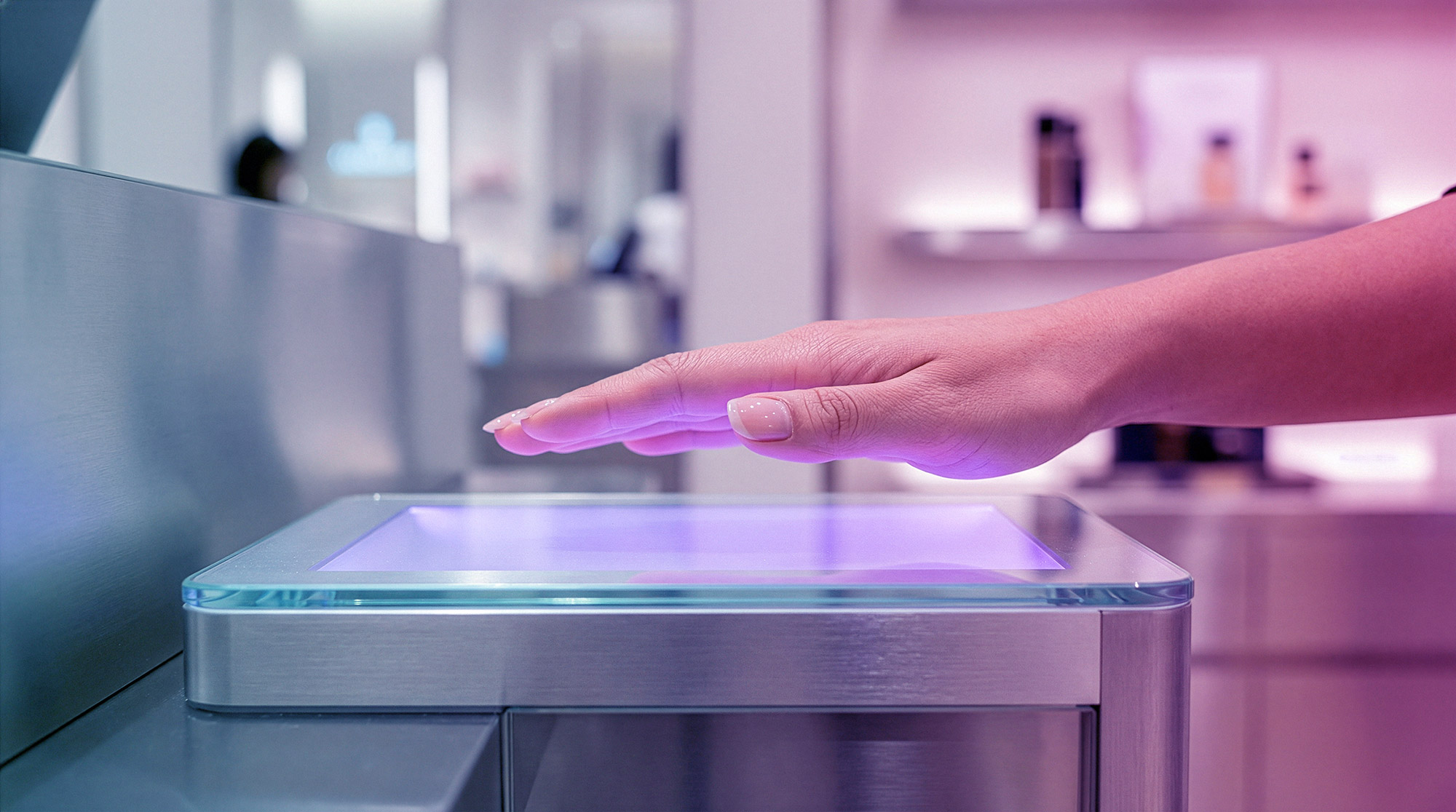
The old saying “know it like the back of your hand” feels almost prophetic in an era where systems that leverage unique biological identifiers, such as palm-vein patterns and facial recognition, offer unparalleled security and convenience. The rapid evolution of biometric payment technologies is changing the present and future of financial transactions by streamlining even more transactions and eliminating the need for physical cards or smartphones. No longer just the realm of the carnival palm reader tent, technologies that utilize palm-vein mapping deliver a secure and user-friendly payment method.
But while new biometric methods represent substantial progress, they also carry inherent risks, particularly when users might be coerced into making payments due to threats of violence or intimidation. Existing biometric payment solutions, while secure against conventional fraud, do not adequately address the issue of duress. Given that biometrics are inseparable from the individual, coercion can become a significant threat.
To counter this vulnerability, a sophisticated method for real-time physiological assessment that can detect abnormal stress to prevent coerced transactions is essential. This is where innovation must step in. Payment technologies need to evolve beyond identifying who you are to understanding how you are. In real time.
A solution for the issue of coercion is combining biometric data collection with physiological state analysis via biometric scanners and wearable devices. This can offer robust, real-time stress detection.
Palm-based biometric systems, like those deployed by Amazon One, use infrared imaging to map vein structures. Enhanced versions of these same systems can simultaneously measure skin temperature and sweat gland activity, which are both reliable stress biomarkers, And they can do this without requiring additional user actions. Accurately capturing subtle physiological changes that indicate stress or fear provides an unobtrusive solution for real-time duress detection.
Facial recognition systems further complement this capability by using sophisticated image processing algorithms to analyze facial expressions and micro-expressions. The integration of these diverse biometric sensors significantly improves the accuracy and reliability of emotion detection by ensuring comprehensive multimodal data capture.
Wearable devices such as smartwatches and augmented reality (AR) glasses can add another level of security. Once registered with the user's biometric identity through secure multi-factor authentication processes, these devices continuously monitor physiological data like heart rate, skin conductivity, and other indicators correlated with stress. Upon initiating a biometric payment, these devices use short-range wireless communication protocols like Bluetooth or Wi-Fi Aware to transmit stress-related physiological parameters to the payment terminal for verification. This continuous data stream allows the system to differentiate effectively between normal physiological states and those indicative of coercion.
Like Los Angeles Lakers’ Lebron James has unique handshakes with each member of his team that act as a personal code, adding gesture recognition techniques to payment confirmation can further enhance transaction security. By giving users the ability to register specific gestures that correspond to particular payment methods, such as choosing between multiple credit cards or splitting payments among multiple accounts, the gesture recognition system adds convenience. Optical sensors capable of capturing hand movements in visible or infrared spectra can interpret hand signals through sophisticated semantic classification algorithms so users can easily manage their payment choices in real-time without needing additional interfaces.
When a user performs a registered gesture, the system identifies and matches it to the corresponding payment method. If no gesture is provided, the system defaults to a predefined primary payment method. This flexible approach significantly enhances the convenience and practicality of biometric payment systems by allowing nuanced transactions without compromising security.
Why does better biometric security matter for businesses and consumers? Put simply: peace of mind. Integrating duress detection and gesture management into biometric payments addresses security and convenience, two of the biggest consumer concerns. Reassuring customers that their safety is paramount, while also offering them a more personalized and intuitive payment experience, is a huge win. Especially, in a market where trust and ease-of-use determine adoption, this can be a major differentiator. Retailers, financial institutions, and technology providers that invest early in these capabilities position themselves not only as innovators but also as trusted guardians of consumer safety.
But the potential extends far beyond retail. From ATMs and airport security to smart homes and connected vehicles, real-time physiological monitoring could redefine how we authenticate and protect people across countless environments. Biometric payments in all these scenarios are appealing for a number of reasons. You can’t lose your palm or face, and they’re uniquely yours. They’re fast, hygienic (no passing around germy cards or phones), and add a layer of fraud protection traditional cards can’t match. The technology could also enhance personal security features in smart home environments, offering automatic alerts or security actions in response to stress detection. Combined with advances in wearable tech, the vision of a future where technology doesn’t just recognize us but also understands us is extremely exciting.
The next leap forward isn’t just about refining the hardware but about enriching the experience with intelligence. At Adeia, we have a vision of where biometrics are going and we’re always working on that next step. By combining biometric identification with stress detection and gesture-driven personalization, we’re building systems that are not only secure but also deeply human.
The question isn’t whether this transformation will happen, it’s how quickly businesses will embrace it. Come join us ahead of the curve as we fundamentally enhance the security, functionality, and appeal of biometric payment technologies.

Jean-Yves Couleaud is Senior Director of Advanced R&D at Adeia. His role is to develop new ideas to enrich Adeia’s media portfolio in the video streaming, connectivity, advertisement, and imaging domains. Prior to joining Adeia, Jean-Yves spent more than 25 years in the aerospace industry where he held various engineering positions. He was the technical lead of a team that brought programmatic advertisement to commercial jets’ in-flight entertainment systems as an industry-first and was the Chief Engineer for a cloud-native edge server architecture that was recently awarded a prestigious Crystal Cabin Award. He holds 16 granted patents.
%20(1).png)
%20(2).png)
© 2026 Adeia Inc. All Rights Reserved |
Terms & Conditions |
Privacy Statement|
Accessibility
